
Contents
Maximum Product Dimensions
Individual units or cases must not exceed the following gross dimensions: 24"x18"x14" or 35 lbs.
Restricted Products
Badger does not allow the following product types for inbounding / receiving:
- Oversized products measuring greater than the following gross dimensions: 24"x18"x14" or 35 lbs.
- Products requiring cold / refrigerated storage (Badger only offers temperature controlled storage at 68-75 °F).
- Hazardous materials as classified per DOT 49 CFR.
- Chemicals, fuels, corrosive / radioactive materials, or flammable liquids (some exemptions may apply).
- Illegal products (products prohibited or restricted by law in the place of origin, destination, or any places through which the products may travel).
- Products that have been illegally replicated, reproduced, or manufactured (counterfeit).
- Products that require sterilized storage or FDA registered storage.
- Products with unauthorized marketing materials (copyright or trademark infringement).
- Products requiring specific licenses to store or distribute such as:
- Alcoholic beverages
- Tobacco
- Ammunition & Firearms (including airsoft and "BB" guns)
- Prescription pharmaceuticals and pseudo pharmaceuticals
- Live plants and animals (including imported / illegal or dangerous seeds)
- CBD / Hemp / Cannabis (containing > 0.3% THC)
- High value products with a replacement value greater than $100.
- Monetary / cash equivalents, gift cards, gift certificates.
- Defective or damaged products.
- Loose sharp objects such as knives, cutlery, or needles.
- "Adult use only" products, or products displaying explicit sexual images or words (discreet packaging with no visibility to the product is acceptable).
- Raw ingredients in non-sealed containers (air-tight).
- Ex. paper sacks of powder, grain, seed, feed, pellets, or other food ingredients.
- Fragile products not properly packaged for safe handling and fulfillment (e.g. glassware, ceramics, artwork, electronics, etc.).
- Products that Badger determines as unsuitable or dangerous.
If products in violation of these guidelines arrive at Badger's warehouse, they will be returned or disposed of at the cost to the client. Products that cannot be safely returned will be disposed. Badger reserves the right to deny return requests for and dispose any inventory identified as counterfeit or illegal. Badger is not responsible for any costs or losses incurred related to the disposition of these products.
Barcode Requirements
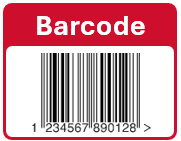
A barcode (also "UPC": Universal Product Code) is a visual representation of data, displayed on the outside of item packaging. The barcode is how computer systems read / identify products (via scanning devices), essential for warehouse receiving, inventory transfer, and fulfillment.
All sellable "units" require a scannable SKU-specific barcode clearly printed or stickered on the outside of the packaging; the barcode is required for scanning during receiving and fulfillment. For "units" also fulfilled in a case configuration, cases should contain their own unique barcode (different than the barcode on the individual units inside).
Only one scannable barcode should be displayed on each sellable unit. If not displayed elsewhere on the packaging - it is helpful to include the product name / description on the barcode sticker.
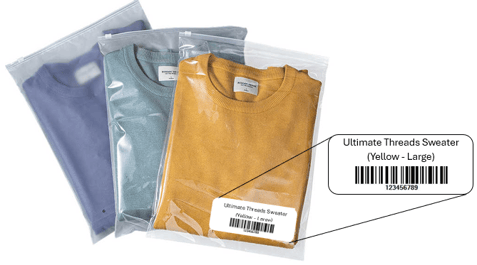
Example Barcode Sticker
Barcode vs. SKU
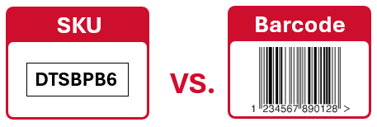
A SKU is a master item code, while a barcode is an associated scannable identification number (the barcode is physically displayed on the outside of the product packaging).
A product SKU may have multiple associated barcodes, however, a barcode can only be associated with one active SKU.
Barcode Format
Barcodes should be formatted under one of the following "linear" (1-dimensional) product code systems:
- Universal Product Code (UPC-A)
- Global Standard 1 (GS1)
- International Article Number (EAN-12/13)
- Code 128 or Code 39
- Global Trade Item Number system (GTIN-12/13)
- Amazon Fulfillment Network SKU (FNSKU)
- Amazon Standard Identification Number (ASIN)
Examples of common barcode types:
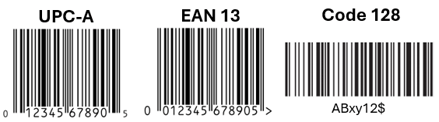
Clients can purchase registered barcodes through the GS1 website or create and assign their own alphanumeric codes. Official UPCs / GS1s are not required, but recommended if you are planning on fulfilling through B2B / retail channels.
Barcodes can be generated from simple text using a barcode generator software (ex. Code 128 or Code 39):
Ex. The text "Shirt" can be converted to barcode format (Code 128):
-jpg.jpeg?width=186&height=93&name=Code-128%20(93)-jpg.jpeg)
2D barcodes (ex. QR codes, GS1 DataMatrix) are not supported.
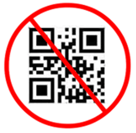
Barcode Size
The following size requirements are of the physical barcode, not the barcode sticker / label.
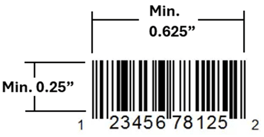
Absolute minimum barcode dimensions (at high resolution): .625" length x .25" height.
Ideal minimum barcode dimensions: 1" length x .5" height.
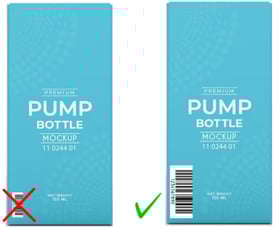
Physical Barcode Display
Barcodes should be printed black against a solid white background, on a flat / smooth, non-highly reflective material. Aim for a 300 Dots Per Inch (DPI) print-resolution.
For barcodes printed directly on clear bottles, jars, bags or other clear materials, barcodes must be printed with a solid white background, as barcode may not effectively scan (otherwise, barcode stickers should be applied).
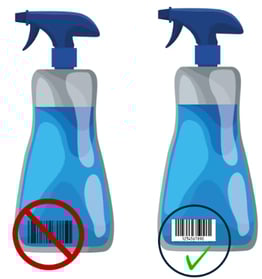
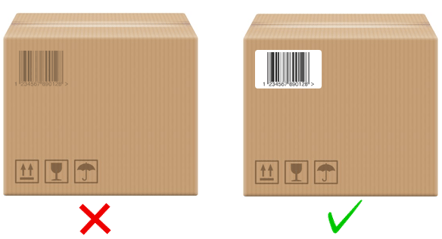
Barcodes printed directly on corrugated material may be distorted and unreadable.
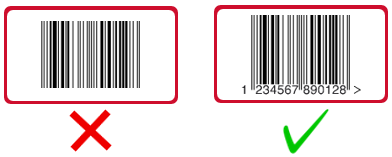
Physical barcodes / stickers should list the actual alphanumeric code in text; if a barcode does not scan properly (i.e. smudged or torn), the text can be referenced and manually input into the system to successfully identify the product.
Barcode Placement
Barcodes must be easily scannable and securely adhered to every sellable unit.
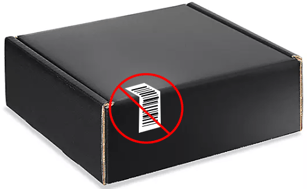
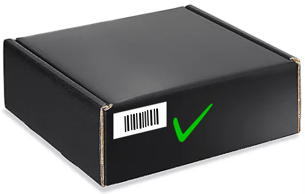
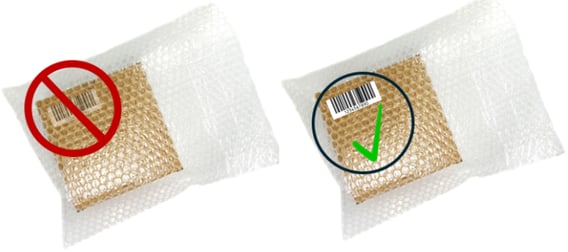
Barcodes must be applied/printed on outside of product packaging such as bubble wrap, as scanners will not be able to effectively scan through plastic material (product packaging should not require opening to properly scan barcode). When possible, barcodes should appear on outside of clear, flat polybags (cellophane material).
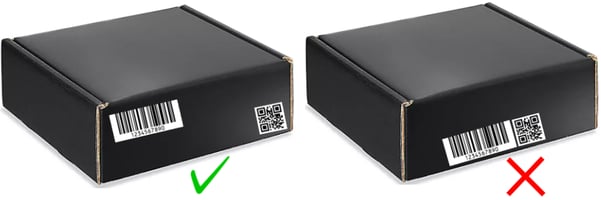
Barcodes should be isolated with sufficient space all around (minimum 1") from neighboring scannable barcodes (e.g. QR codes), to prevent mis-scans.
Barcodes must not be printed on material that easily crinkles or creases, hindering the barcode non-scannable (e.g. loose, thin bags or cellophane material); a barcode sticker should be applied.
Barcode Exceptions
It is best practice for all inventoried items to have a scannable barcode clearly printed or stickered on the outside of the packaging; this provides quality control during receiving, inventory management, and fulfillment.
Include a small scannable barcode on all items when possible
The following product categories allow for exception regarding the barcode requirement: inserts, pamphlets, marketing materials, packaging, and project materials.
Missing / Non-Compliant Barcodes (DTC)
DTC products missing barcodes or products containing non-scannable barcodes will be put "On Hold" status; items will not be available for standard outbound order fulfillment. Clients will be notified via email. Non-scannable items will require one of the following dispositions:
- Badger over-barcode items (Badger's standard barcoding / sticker fee)
- Badger ship items via WMS Shipment Order (created by client)
Packaging Requirements
Clothing / Apparel
Apparel, fabric, plush, and textiles need to arrive packaged in a sealed bag (polybag) with a barcode displayed on the outside of the package; a brief product description on the barcode sticker aids in the sorting and receiving process. Proper packaging assures cleanliness of merchandise during storage and handling.
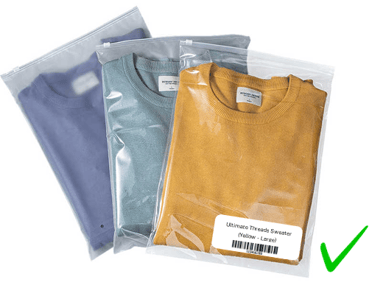
Some states or retailers may require poly-bags contain a suffocation warning label / statement.
Case Pack Requirements
A Case Pack is a box containing multiple identical units, used to streamline logistics for bulk product receiving, storage, and order-fulfillment. Case pack quantities should be consistent across each SKU.
Case Labels
Case-packed product require case labels that clearly state the following information:
- WMS Client-Company Name
- WMS Product SKU
- WMS Product Name / Description
- Product Lot Code (if applicable)
- Product Expiration Date (if applicable)
- Product Production Date (if applicable)
- Case Product Quantity*
- If the case pack is intended for wholesale / B2B fulfillment, the label should contain a case-specific scannable barcode (different than the barcode on the individual units inside). If the product is intended only for unit / DTC fulfillment, it is preferred to omit or cover up any barcodes on the outside of the case packaging.
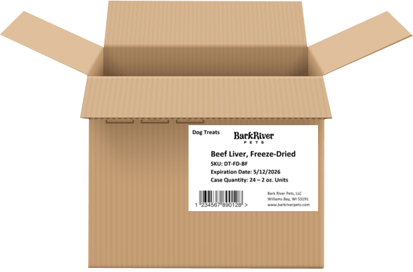
Typical label size: 4”x6” or 3”x5”
Label placement: Quantity 1 label, applied to 1 of the 4 sides of the case (location consistent across each SKU).
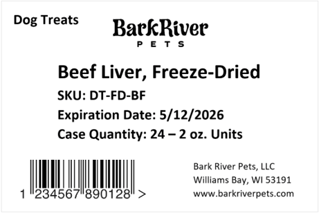
Example Case Label:
WMS Client Name: Bark River Pets
WMS Product SKU: DT-FD-BF
WMS Product Name: Beef Liver, Freeze-Dried
Case-specific Barcode: 1234567890128
Partial Case Pack
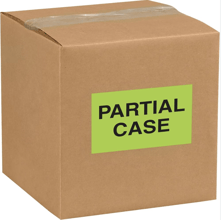
If you are inbounding a partial case pack, apply an obvious label stating "Partial", including the product quantity contained within.
Ship In Own Container (SIOC)
Ship In Own Container (or SIOC) is a product classification that allows a product to be shipped in its original packaging, without any additional packaging required.
This shipping method allows products to be shipped without the need for additional packaging materials, which can help reduce shipping costs, lower environmental impact, and increase order fulfillment efficiencies.
Case-packs intended for outbound fulfillment should be inbounded in a ship-ready configuration, with the following points in mind:
- Durable corrugate to prevent damage or breakage during transit (appropriate cardboard ECT rating for the product size and weight).
- Sufficient void fill for safe handling / shipping.
- Sufficiently sealed all round, to prevent package from opening during transit.
- 3” wide tape vs. 2” wide tape across the seams (i.e. 2” wide tape not sufficient for large, heavy box).
- Use fiber reinforced tape when necessary.
- Sufficient size case to apply 4”x6” shipping and/or retailer labels to 1-2 sides (folding label across the side not ideal).
Carton Drop Test
For products intended to be shipped in their own container, clients are encouraged to perform a "drop test" to ensure sufficient packaging.
A carton drop test is a simulation of the falls that a package may experience during shipping and handling.
To perform a carton drop test:
- Ensure the carton is properly closed and sealed, as it would be for shipping.
- Drop the carton on its most fragile corner, three of its edges, and six of its faces from a height of 24 inches (from bottom of carton), onto a rigid surface.
- After each drop, carefully examine the carton and its contents for any signs of damage, including tears, dents, crushed corners, and damage to the product inside.
- Document the drop height, orientation, and any observed damage.

Results from a drop test will help clients determine the proper box strength, void fill technique / material, pack configuration, etc.
Lot / Batch, Expiry, & Production Date Tracking
If you intend for Badger to record product Lot / Batch Codes, Expiration Dates, or Production Dates upon receipt, this info must be clearly displayed on the outside of unit packaging, and on the case label if the product is case-packed; packaging, including case-packs, must not require opening to see / record this info. "Lot" (or "Batch") and "Expiration" (or "Exp") should be designated in English.
Product Lot / Batch & Expiry information may be referenced in the WMS 'Inventory by Location' report.