Contents
Before preparing shipment, ensure your Products are prepped for inbounding.
All products must be inbounded in boxes (i.e. you cannot ship bags on their own, or bags on pallets). Gaylord boxes, crates, and super sacks are not accepted.
Acceptable Dunnage
"Dunnage" refers to the materials used to pack and protect items during shipping and handling (often referred to as "void fill").
Acceptable [inbound] packing materials include:
- Kraft paper (preferred)
- Air pillows
- Bubble wrap
- Cardboard inserts
- Foam sheets / blocks
Do NOT use packing peanuts or shredded crinkle paper (or any other fine / shredded material).
Multi SKU Boxes
If inbounding multi SKU boxes, you must segregate SKUs within the box using bags, inner cartons, or rigid cardboard dividers (assume contents will get "jumbled" during transportation). If applicable, further segregate SKUs by single Lot/expiration. On the outside of each inner bag or inner carton, list the WMS Product-SKU, SKU quantity, and if applicable - Lot code and expiration date (do NOT include the product barcode). Multi SKU boxes that arrive mixed up will require additional receiving time (sorting) and incur associated fees.
Ground / Small Parcel
Ground or Small Parcel refers to shipping product in boxes, via ground carrier service (i.e. USPS, FedEx, UPS, etc.). If the total weight of your shipment exceeds 250 lbs. it is recommended to ship product on pallets.
Shipping cartons must not exceed the following dimensions: 24”x18”x14” or 50 lbs.
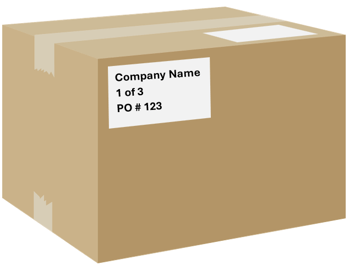
Include the WMS Receipt Order Number on shipping labels (reference field) and/or on separate box labels; also helpful: if the shipping labels do not contain box numbers, include box # / total shipment [box] quantity on separate labels.
Example:
Freight (Pallets)
Freight refers to shipping product in boxes on pallets via freight truck / trailer (gaylord boxes, crates, and super sacks are not accepted).
Clearly display the WMS Receipt Order Number on the outside of all pallets and include on the Bill of Lading (reference field); also helpful: display the pallet # / total shipment [pallet] quantity on one of the sides of each pallet.
Boxes should not overhang the edges of the pallet. Pallets need to be completely plastic-wrapped (or banded) for safe handling and storage; only use clear plastic wrap so the pallet contents can be verified / counted.
Pallets should be built single SKU and single Lot/Expiration when possible. If a pallet contains multiple SKUs or multiple Lots, a label must be applied on one of the sides clearly stating: "Mixed SKU", "Mixed Lot", or "Must Break Down".
Case packs should be arranged in a consistent layer / pallet configuration (uniform TI-HI), with case-labels upright and turned outward. Partial case packs should be placed on the top layer of the pallet and be clearly marked “Partial”.
Maximum Pallet Dimensions
40 inches x 48 inches x 55 inches
Max pallet height (from the bottom of pallet to top of product): 55 inches. Pallets measuring taller than 55 inches will require additional time for receiving (break down) and incur associated fees.
Pallet Requirements
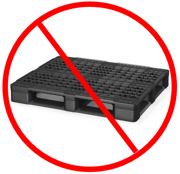
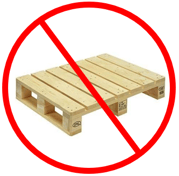
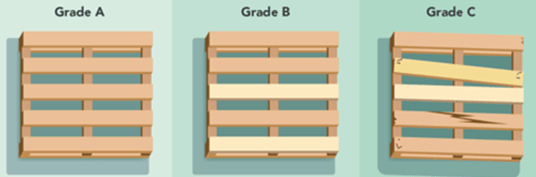
GMA (Grocery Manufacturers Association) standard 40” x 48” Grade A/B wood pallets should be used (4 way access - notched stringers). Wooden pallets should be heat treated following the ISPM-15 standards to prevent rot, insects, pests, fungi etc.